When talking to friends that planned traveling to China, I found that they often struggle with figuring out mobile data plans. This is intuitive because you should take care not to get cut off by the great firewall, making most western social media and services inaccessible (Facebook, WhatsApp, Google, etc) and information on how to circumvent it is scarce. This article is a bunch of notes on SIMs in China.

While China is a fascinating and pretty country, it is infamous for its great firewall. Of couse you can navigate China without western services (obviously, most Chinese do it everyday :)) and Google Maps is actually almost useless in mainland China1 . You will definitely need to install a number of local apps (WeChat for example) to be able to book trains2, museums, hotels and pay in basically any shop. However you probably still want to keep in touch with your friends back home and Line, WhatsApp and Facebook all won’t work in China. Neither do Google or most Microsoft services.
The easy way: BNE SIM
The by far easiest way for me was to start with my go-to eSIM provider, BNE SIM. When I use them in Germany, they are extremely cheap, even if a bit wonky regarding connection and app stability. But it works, and covers every country including China.
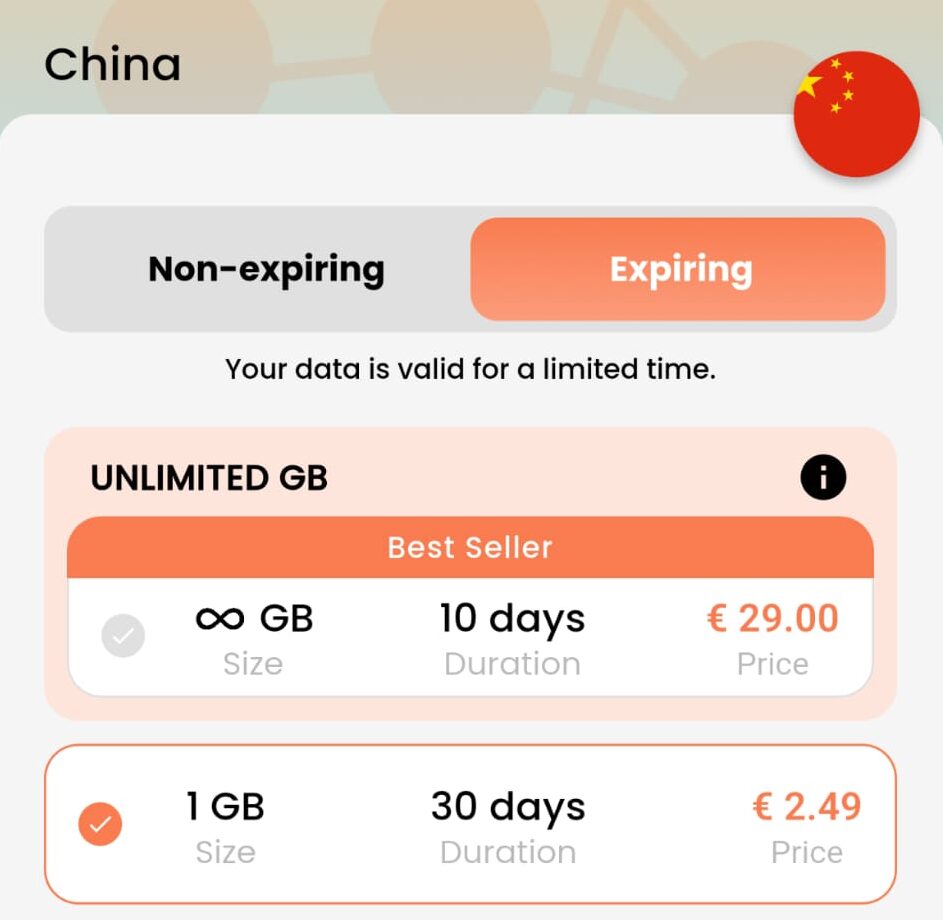
Inside the “Add SIM” menu, I booked an eSIM for China. This eSIM worked in Hong Kong as well. And I think this is part of the reason for why this eSIM is such a great option for foreigners that want to continue using US-based services like Google.
Built-In VPN
The clear benefit of BNE SIM is that it includes a VPN. I don’t mean the additional VPN offering by BNE SIM, but actually that the SIM by default circumvents the “Great Firewall”, which blocks off traffic to many sanctioned US-services from, among others, the US. Think of every Google service, News websites etc.. Having the VPN as a default was very convenient to get started. Further I did not experience a problem of Chinese websites blocking me, although I might not have noticed because I do not use many of them.
There are, however, two downsides:
- First, it seems that it does not work in every city. For me it stopped working in Changsha, which is not a city tourists go to usually. But it worked anywhere else, e.g., Hong Kong, Guilin, Zhangjiajie, and in all cities I visited along the east coast up to Shanghai.
- Second, it is a bit expensive, costing 1€ for 1GB in the smaller plans.
If you don’t mind these, or want a backup to the local SIM, I can highly recommend them. You can get 3€ off by using this referral code (which only benefits me in getting BNE Credits, and I do use them, if that reassures you :))
Install the App: https://apps.bnesim.com/?esim_app=1
3€ Discount Code (enter at checkout): 6UEUT62E
The local way: Local SIMs
You can also buy a physical (and probably also virtual) SIM locally in China. I bought mine at the arrival airport in Shanghai. Do make sure to ask different providers, they are used to this and won’t bother. You may need to ask explicitly how much it costs. I found a provider for 15GB of data for less than US$10. Now writing this article I realize that BNE SIM also has similar offers. Don’t ask me why I did not consider them when I travelled myself.
The clear benefit of these SIM cards is that they will work everywhere and usually have very stable connection and fast speed. The downside is that you will need to bring your VPN.
Bring your VPN
I say bring because you will likely not be able to find an offer from within China. And this VPN should be a business VPN or some other bespoke setup. The reason is that the Chinese authorities are not stupid and blocked most of the common VPNs, such as NordVPN (which I tried). There are VPNs offered by universities and free ones hosted in Japan3, which will take a bit to set up but will likely work.
I would always recommend to have a VPNs ready. If you connect to the hotel WiFi for example, it will also be behind the firewall. So you’ll be happy to have a VPN if you want to save a bit on your data, or need to re-bootstrap your internet when mobile data ran out.
While I am sure there are also other ways to get a working SIM for China, including other eSIM providers like Nomad and Saily, I personally haven’t tried anything else. If you did, feel free to share it in the comments. If you are planning to travel, I am sure other blogs have different recommendations.
References:
- https://medium.com/@anastasia.bizyayeva/every-map-of-china-is-wrong-bc2bce145db2 ↩︎
- This may or may not be useful to you. I used chinahighlights.com for some bookings, which has the benefit that they will accept your booking before it is officially possible to book the train. They take a small fee though, which you can save by booking directly in WeChat. ↩︎
- https://www.vpngate.net/en/ ↩︎
Hey, thanks for sharing! I wanna ask which data plan you bought from BNE. China-specific, Asia-wide, or (mini)Global? Or you bought an other-country-specific (e.g., Singapore) plan and “roaming” in China? I am just worried that BNE gives me a Chinese IP address that would apparently be blocked by the Great Firewall. So, could you please share more details if it’s permitted? Thank you so much!
I did book a China-specific card. No idea about how and why it was not blocked at the end but it is likely related to the fact that it also worked in HK.